Showing posts with label sheep. Show all posts

Sunday, April 21, 2013

SS: Cheviot

Ready for another installment of my ongoing Spinner's Study?


My thoughts on Romney align with what I wrote in my last post, which is that it's known to be an all-around good workhorse of a fiber that plays nicely, and that definitely seems to be true. It drafted smoothly and easily and made a nice, strong-feeling yarn with just a little bit of shine to it (from its longwool nature).


The wool from the next breed, Cheviot, feels somewhat similar.

Photo from wikipedia
The Ceviot is a dual-purpose sheep, raised for both meat and wool, and comprises its own 'family' within the Fleece and Fiber Sourcebook. It is the dominant breed in the Cheviot Hills area on the border between England and Scotland.The sheep themselves have 'clean' faces free of wool with dark eyes and noses and their origin is something of a mystery (rumors of sheep escaping from Spanish ships) but they've been around since sometime in the 15th to 17th centuries.

Long staple length with '3-dimensional crimp'
The book describes Cheviot as a neighborly fiber known for durability without harshness. It has a micron range between 27 and 33, which lands it squarely in the medium softness category, edging towards coarse. The book also calls the fiber 'chalky', which is kind of a strange word to apply to wool, but I think I get it. 


The fiber I have is almost fluid in how it drafts, there is no luster or silkiness but the fibers aren't 'grabby' either, they don't grip each other very tightly. Even though it has a long staple length, I have to watch that I don't draft out too quickly and create thin spots in the yarn. That said, it's been very easy-going to spin, and I could see how it would make a great rugged sweater or blanket, since I imagine the fabric wouldn't pill much with wear.

If you like learning about different types of wool, I highly recommend you check out the free Craftsy mini-class "Know Your Wool", taught by Deborah Robinson (one of the authors of the Sourcebook). I watched it the other night and thought it was a great summary and introduction to some of the key concepts in understanding the differences between types of wool.

You can also find info on the other breeds I've already spun up here.


Friday, April 5, 2013

Baby-palooza

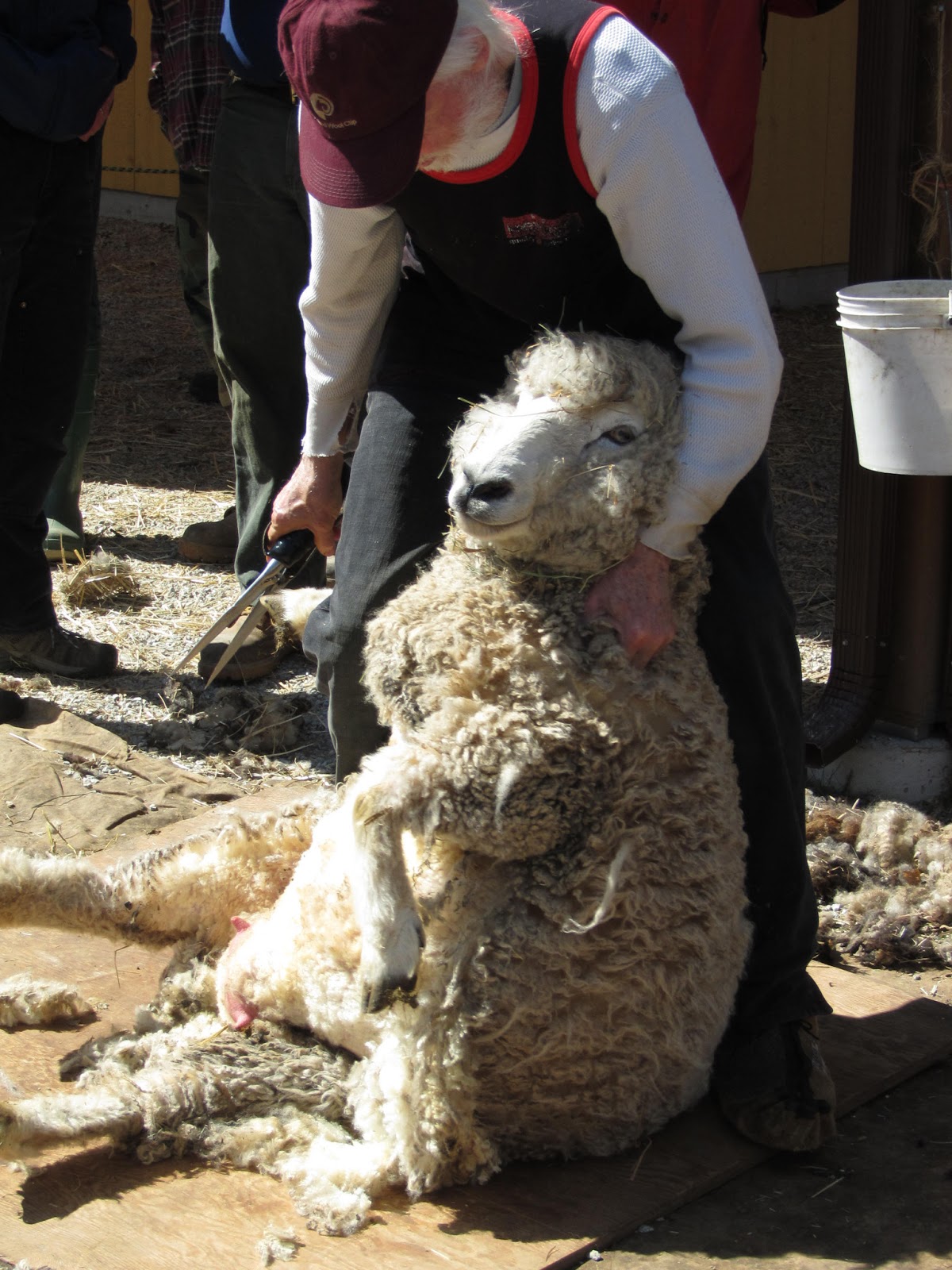
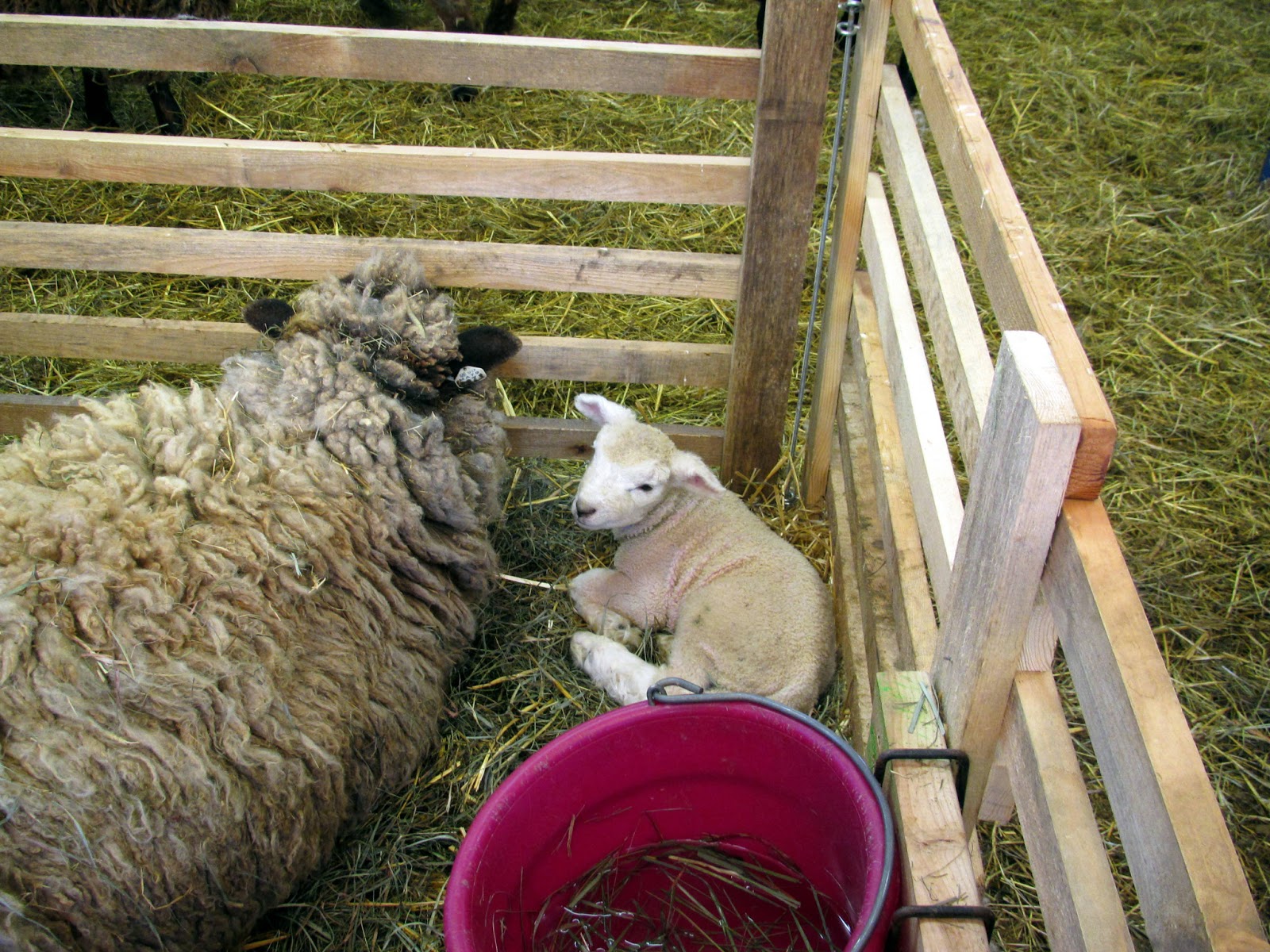
Last Saturday the Fiasco and I went to Woolapalooza, a little sheep festival at Drumlin Farm in Lincoln, MA. On the drive back, we visited our good friends who had recently had a sweet baby girl for whom I had been knitting many things. Between the lambs and goat kids and tiny humans, it was a veritable baby-palooza and nearly too much cute for one day. Prepare yourselves.

Favorite part of the sheep shearing was when a 7-year-old boy explained to whomever would listen: "See that pink part?         That's the penis. Or maybe it's the lady penis. I'm not sure how that works." (It was the udder!)

Clean white wool underneath.
Lamb!

Two lambs!

A leicester of some sort?

Don't know her breed but she sure is cute! (Romney?)

Angora bunny

Three little goat kids.

Brand new baby, the mama was still dealing with the umbilical cord!

Sunshiney snuggles

Candid shot of my Beribboned Hat and Syrinx Shells cowl in the wild!

The color markings on these goats were just lovely.

Babies and mama!

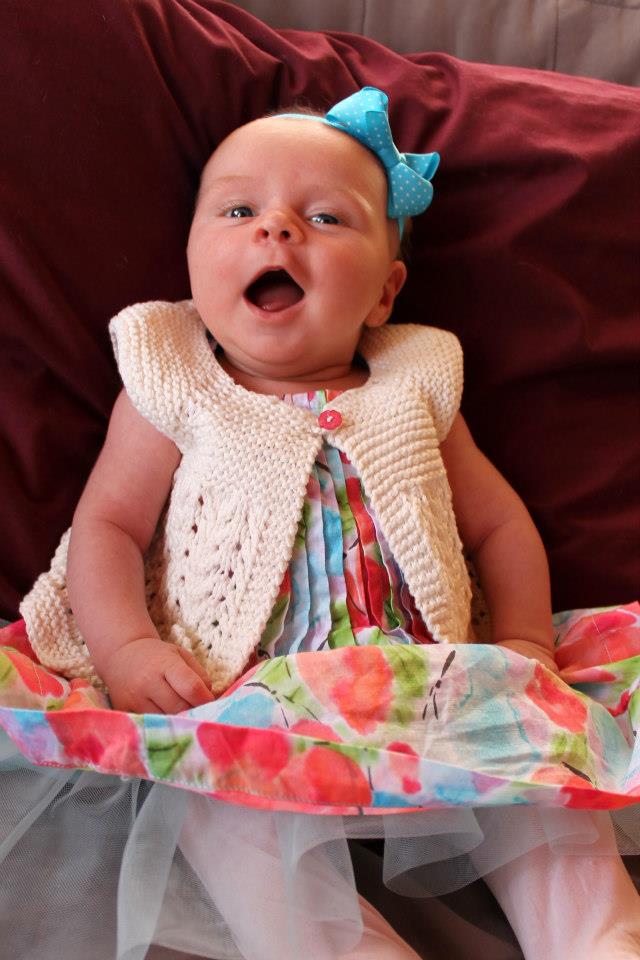
Now for a human baby (Hi, Lyra!) and mama (Hi, Bridgi!)
My, what a lovely hat you have!

Prior to this photo, the Fiasco made a crazy face that both stunned and amused the wee one.

I stole this photo straight from Bridgit's facebook because the sweater she knit to to go with Lyra's Easter dress is just too sweet not to share! 

I hope you've had your fill of adorable things today. :) You're welcome.

Wednesday, February 13, 2013

SS: Romney

It has been ages and ages since I wrote a Spinner's Study post. The last time I did, I gave a quick rundown on some of the fascinating history of the Merino breed. Here's the plump little skein I finished:


As you might image, the Merino wool made a lovely, soft, and squishy single. If I had plied this, the resulting yarn would've displayed a lot of elasticity and bounce, which is characteristic of the fine crimp pattern in Merino staples. Its elasticity is one reason why Merino wool is so loved for fabrics and for socks in particular. However, the fiber's fineness works against it for socks, making it prone to pilling and wear, as seen in the pile of socks waiting to be mended. However, for me, the bounce and softness of Merino is worth a few minutes of darning every now and then.

Onto the next breed! We took a brief look at Romney wool when I described the For the Love of Longwools class I took at Rhinebeck. Now, we'll dig a little deeper.

This handsome devil's photo came from Wikipedia.
The Romney sheep is a dual-purpose meat and fiber breed that is grouped with the English Longwool Family in the Fleece and Fiber Sourcebook. It was developed from crossing a breed native to the Ronney Marsh coastal plain in southeast England with longwool Leicester bloodlines. This imparted a long staple length and luster to Romney fiber, while still maintaining the breed's unique adaptations allowing the growth of quality wool in boggy, marshy environments.


According to the FFSB, "Romney fleece is most likely to be voted president of the Wool High School senior class. It can't do everything, but it's an all-around good citizen and extremely versatile, with personality and charisma. It's a classic." Romney fiber can range in quality and fineness depending on the particular sheep and location (North American and British are somewhat finer than New Zealand Romneys), but in general it ranges from coarse to fairly fine (micron count 29-37) and is usually finer than other longwool breeds (but you still might not want to wear it near sensitive skin).


I am enjoying this bit of Romney I am spinning much better than the first Romney I tried during the longwools class.  This is perhaps due to the preparation (carded roving vs. commercial combed top) but it could just be nicer fiber. This bunch is drafting very smoothly and creating a strong-feeling, even single. The roving I am spinning here is from Alder Brook Romneys in Connecticut. A friend of the Fiasco's also raises Romneys, shears them herself, and sells handspun yarn from her flock in her Falling Star Fibers Etsy shop. I purchased some fiber from her at a festival that I still have stashed but I'm tempted to skip ahead and just buy some of the lovely finished yarns she has in her shop!

Have you used Romney fiber/yarn? What did you think of it?

Wednesday, January 9, 2013

For The Love of Longwools

In the spirit of catching up on spinning-related things for the blog, I figured it was finally time to tell you about the class class I took way back when at Rhinebeck called For The Love of Longwools. Longwool sheep, as you may or may not know, are breeds that produce wool with a very long staple length, relatively little crimp/elasticity, and usually a lot of luster/shine. They are basically the opposite of the very common fine wool Merino, which has tons of bounce and softness, a short staple length, and no shine. This means that longwools can and often should be spun into yarns that will look and act differently than those made with Merino wool.


The class was taught by Beth Smith who owns The Spinning Loft in Michigan. Her shop carries all sorts of spinning materials, including raw fleeces if you wish to give washing your own a try (someday). The bulk of the class was mostly just trying out 5 different breeds of longwools. For 3 of them, fiber was provided as washed locks, so we learned to comb them and use a diz to create fluffy top (see Sara's blog post on A Year At The Wheel for a great photo tutorial on the process). For the other 2, we received commercially processed top to play with. I learned how to Andean ply from a fellow classmate, which allowed me to use my hand to wrap some yarn in such a way that I could make 2-ply samples with no lazy kate, bobbins, or toilet paper rolls involved (that link shows a slightly different process than I learned but is the same idea). It was a great experience to be surrounded by so many spinners with so much love for their craft and it's definitely something I'll do again the next time I get to go to a festival. Now, onto the spinning!

English Leicester:


In these photos, the left image has the washed locks in the top left, the combed fiber in the top right, and the 2-ply yarn is in front. The right image shows a closeup of the yarn. These yarns are small samples fresh off the spindle, not washed and set like you'd usually do with finishing. English Leicester was probably my least favorite of the wools we tried. It was the brightest white, which probably means it would dye wonderfully, but it also had the wiriest feel to it, much more hair-like than wool-like. The locks do have a very cool wave to them, though, and it was easy to comb and spin into a shiny yarn.

Coopworth:


Even though Coopworth wool was also more on the hair-like side of things, I liked it better. Perhaps it's because the locks had a tighter crimp, which made them act a bit woolier during combing and spinning? A sample of Coopworth came with my Golding spindle when I got it, which I proceeded to turn into a thick, wiry yarn, but I think I could do much better with it now that I know more about drafting and the right amount of twist. The finished yarn spun up very easily and has a decent amount of bounce to it. It is also very, very strong-- you wouldn't want to try to break this one by hand.

Blue Faced Leicester:


Of all the longwools we tried, the Blue Faced Leicester felt the softest and wooliest. It even had a bit of a lanolin feel to it in the washed locks, which had the most crimp of them all. I love those little ringlets! Possibly because it was the least foreign to me, I liked the way the BFL spun up the best. The finished yarn is soft and lush-feeling but still has a great shine and when knit up would probably drape nicely. What's also nice about BFL is that it's one of the most widely available single-breed yarns on the market besides Merino, so you could try knitting with it fairly easily.

Romney:


For this and the next breed, we received the wool as commercially prepared top, not locks, so we didn't comb it ourselves. The Romney had a very long staple length with very little crimp at all, the fibers all seemed straight and relaxed. I didn't really get very strong impressions from this wool, honestly. The resulting yarn is a bit course and does not have a lot of bounce nor does it have a lot of shine, it feels kind of in between on everything. I know a lot of people really like Romney, so this could have had a lot to do with its preparation or with the way I spun it (from the fold) and it might like it better to be worsted spun or carded into roving and then woolen spun. I'll have to experiment because I now have plenty of Romney to play with in my fiber stash.

Wensleydale:


This Wensleydale is the last of the breeds we tried and I really liked it. It is very different than fine wools, with its long staple length and smooth-to-nonexistent crimp, but it has such a lovely, silk-like hand to it that it ranks right up there with BFL for me. The fibers are very fine and smooth and spin up into an incredibly shiny and silky soft yarn. I would definitely like to spin more and knit with it, I bet it would have a gorgeous drape. Also, the sheep themselves are freakin' adorable:

From the Wensleydale Sheep official site
 AmIright?? Look at those luscious locks!

Giveaway!!

I hope you enjoyed my whirlwind tour through a few longwool breeds, it was fun for me to document. Since I have some locks and top left over, I'd like to share them with one of you! Leave a comment telling me what your favorite breed of sheep to spin or knit is (or a breed you'd most like to try) and I will draw a random winner to receive a little bundle of fiber of each of the 5 types I talked about next Wednesday. Yay for sharing! ;)

Monday, January 7, 2013

A Spinnerific Start

I decided to start this week off right by sprucing up the spinning info on this blog. Firstly, I updated the blog pages to include one specifically about my ongoing Spinner's Study with links to related blog posts for each breed of sheep explored. I also updated my tabs for handspun WIPs and FYs and my 2013 fiber and knitterly goals. Next, I realized that I was so engrossed when I got my wheel that I haven't even updated you on the fiber I received for the holidays yet! So I'm going to try to catch up on all of that now. (Buckle up, there's quite a bit.)

My parents gifted me with enough fiber to basically double my stash, which is crazy but awesome! I'm particularly excited about the above braids of fiber because they are all from Scandinavian or British breeds of sheep with much different characteristics than your standard fine Merino wool. It will be an exciting challenge to spin these into different yarns, which I'm even more eager to start after reading Pure Wool, a book entirely about using UK single-breed yarns. The Two Sisters Stringworks etsy shop has an interesting variety of breeds that I encourage you to check out. Fibers #1 and #2 are Gotland, which I spun for my Spinner's Study and really enjoyed. Fibers 3 & 4 are Icelandic, which I have also sampled before, and fiber #5 is something I haven't tried yet, Welsh Mountain wool. I'd like to get my hands on a pair of combs first, though, so these might have to wait a little while.


I was particularly touched when the Fiasco's uncle made a trip over to Alder Brook Farm in Connecticut to find yarn and fiber for me. When trying to figure out what to get me for Christmas he asked the Fiasco "she's really into this spinning thing, huh?" and since the answer was yes, he went out and got me 14.5 oz of Romney wool and a skein of handspun yarn from the farm! (As well as an antique spinning wheel flyer, not pictured.) The fiber is really, really nice and I'm excited to see how much yardage I can get from it, I'm sure it'll be enough for a large project... maybe even a sweater or vest?


Again from my parents, the above fiber is from a new-to-me etsy shop, The Wacky Windmill. Numbers 1 & 2 are blends of 70% superwash Merino wool and 30% SeaCell (a cellulose fiber derived from seaweed) in "The Shire" and "Bugsy". She has some really fun colorways that I think will make interesting yarns. Number 3 is a braid of 100% Portuguese Merino wool dyed in a gradient from blue through purple to green. I've already started to experiment with this one, but you'll have to wait to see the results because blogging about all that fiber has worn me out!

Have you discovered any new or exciting fiber sources lately?

Tuesday, October 23, 2012

Rhinebeck Rundown

My first Rhinebeck trip was quite an experience! It was a gorgeous weekend, the weather cooperated wonderfully, I saw more yarn and fiber in one place than I ever have in my whole life, and I got to spend some time with my real-life-knitter-friends-from-college Bridgit and Jeremie. Yay all around! Now, prepare for lots and lots of photos...

Parting words from the Fiasco. It was difficult to follow them, but I did.
We're here! We're here!
Our first stop was The Fold, to get some Blue Moon Fiber Arts goodies before it became too packed.
Next we stopped by the Burgis Brook Alpacas booth to see my new hat pattern in action, yay!
Then it was Cephalopod Yarns time! Meet Sarah, dyer extraordinaire
And say hi to Jeremie and Bridgit, looking cheerful during our very long wait in the CY line!
Also meet Marianne, a wonderful  friend from the SG/CY/VG boards whom I was very glad to finally see in person.
Enough people, now sheep! Hello, Romney.
Blue Faced Leicester, I love your wool!
Why so serious?
A friendly Finnsheep.
I must have Pygora goats someday!
I coveted this Sheep Incognito artwork, it was great.
There were 3 of these giant buildings and about 10 barns CHOCK FULL of yarn and fiber.
A pair of rather unhappy llamas...
And tents with even more goods strewn between buildings.
Pretty weaving.
A very nice pan flute band.
Some of the gorgeous creations entered for judging.
I adored this picture!
Too many cute things...
There were so many things to see, these photos only covered a small portion of it, but I hope I captured the feel of what it was like. In short, it was wonderful, and I hope I get to go back someday.